
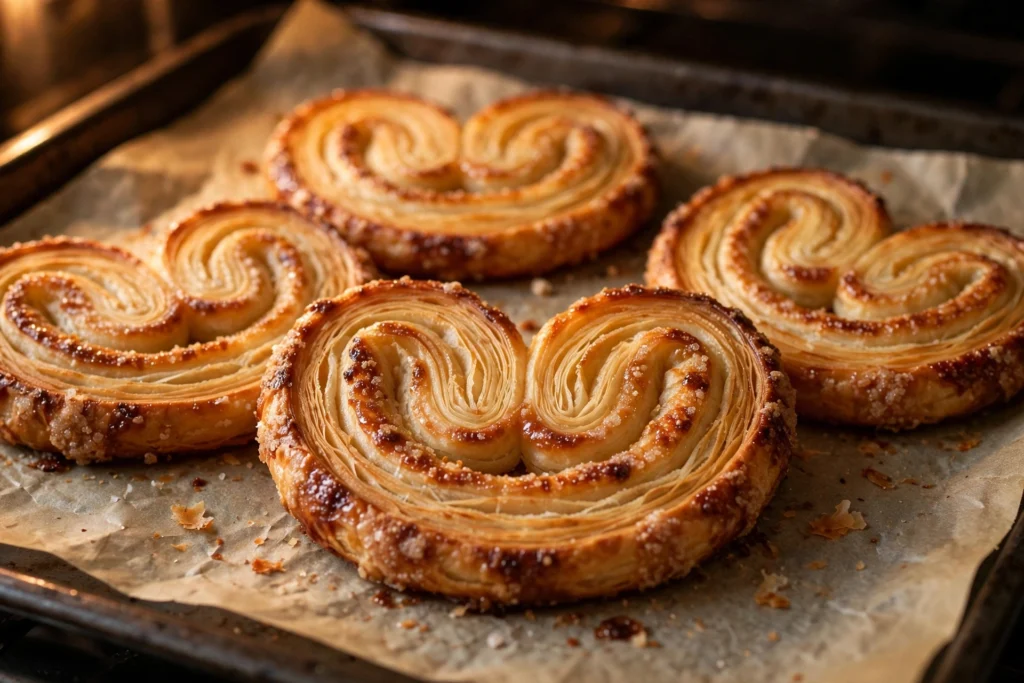
Palmiers are the French bakery classic that looks far fancier than it is — crisp, caramelized, heart-shaped cookies made from just puff pastry and sugar. You roll the dough in sugar, fold it into itself a few times, slice, and bake until the edges turn deep golden and the sugar melts into a crackly caramel shell. The result is shatteringly crisp on the outside, delicately flaky inside, and sweet in that buttery, almost toffee-like way that makes it impossible to eat just one.
This is a three-ingredient recipe built for a store-bought puff pastry sheet, which means the whole thing comes together in about 15 minutes of hands-on work plus a short chill and a quick bake. It is the perfect last-minute dessert for coffee, a tea-time treat, or a sweet snack to keep in the cookie jar. A dusting of cinnamon or a whisper of vanilla sugar turns them into something even more special, but the classic plain-sugar version needs nothing at all.
Why You’ll Love This
- Only 3 ingredients and 15 minutes of hands-on work.
- Shatteringly crisp and caramelized, with delicate flaky layers.
- Perfect with coffee or tea, and impressive enough for guests.
- Easy to customize with cinnamon, vanilla, or orange zest.

Palmiers
Ingredients
Method
- Preheat the oven to 200°C (390°F), or 180°C (355°F) fan, and line a baking tray with parchment paper.
- Sprinkle sugar on the work surface, lay the puff pastry on top, and sprinkle sugar generously over the upper side.
- Fold the right and left sides to meet in the center, press lightly, and sprinkle with more sugar.
- Fold both sides to the center again and sprinkle with more sugar.
- Fold the two long sides over each other to form one long, compact roll and press gently to seal.
- Chill in the fridge for 15 to 20 minutes.
- Slice into pieces about 1 cm (0.4 inch) thick and place on the tray with space between them.
- Bake for 12 to 15 minutes until deep golden brown and caramelized, then cool on the tray for a few minutes before moving to a rack.
Ingredient Notes
- Puff pastry: Use an all-butter puff pastry if you can find it — the flavor is noticeably richer and the layers bake up taller and crisper. Thaw it in the fridge until it is pliable but still cold; warm, soft pastry is hard to fold neatly and will not puff as well. If your sheet is very thin, roll it out gently to an even rectangle about 3 mm thick.
- Sugar: Fine sugar (caster sugar) works best because it dissolves and caramelizes evenly without leaving gritty patches. Granulated sugar is fine too, but avoid coarse or raw sugar, which melts unevenly and can leave hard crystals on the surface.
- Cinnamon or vanilla sugar: Entirely optional, but a teaspoon of cinnamon mixed into the sugar gives the palmiers a warm, spiced note, while vanilla sugar adds a soft, floral sweetness. Keep the amount small so the sugar can still caramelize cleanly.
How to Make Palmiers
- Preheat the oven. Heat the oven to 200°C (390°F) top and bottom heat, or 180°C (355°F) fan. Line a baking tray with parchment paper.
- Sugar the work surface. Sprinkle a generous layer of sugar over your work surface and lay the puff pastry sheet on top. Sprinkle sugar generously over the upper side as well. If using cinnamon or vanilla sugar, mix it into the sugar first.
- First fold. Fold the right and left sides of the pastry to meet in the center. Press lightly and sprinkle a little more sugar on top.
- Second fold. Fold both sides to the center again, the same way, and sprinkle with more sugar.
- Final fold. Fold the two long sides over each other to form one long, compact roll. Press gently to seal.
- Chill. Place the roll in the fridge for 15 to 20 minutes. Chilling firms the butter so the slices hold their shape and the layers stay distinct.
- Slice. Cut the roll into slices about 1 cm (0.4 inch) thick and lay them flat on the prepared tray, leaving space between them — they will expand considerably as they bake.
- Bake. Bake until deep golden brown and caramelized, about 12 to 15 minutes. Check them near the end: the sugar goes from golden to burnt quickly. Let them cool on the tray for a few minutes, then move to a rack.
Tips for Success
- Keep everything cold. If the pastry softens while you fold, pop it in the fridge for 10 minutes before continuing. Cold butter is what creates the tall, separate layers.
- Do not skimp on the sugar between the folds — it is not just sweetness, it is the caramel shell. Every fold should have a fresh sprinkle.
- Slice with a sharp knife in one clean motion. Sawing back and forth squashes the layers and makes the hearts lose their shape.
- Watch the last two minutes closely. The caramelized sugar darkens fast, and the difference between perfectly golden and bitter is about 60 seconds.
- If some palmiers unroll slightly in the oven, gently press the centers back together with the back of a spoon while they are still warm and soft.
Serving Suggestions
Palmiers are at their best slightly warm from the oven, with coffee or tea. They are wonderful alongside a scoop of vanilla ice cream or a bowl of fresh berries, and they make a beautiful, effortless addition to a dessert platter or a brunch table. For a fancier finish, dip one end of each cooled palmier in melted dark chocolate and let it set, or sandwich two palmiers around a spoonful of whipped cream and fresh strawberries.
Storage
Store cooled palmiers in an airtight container at room temperature for up to 5 days — they stay crisp best in a tin rather than a plastic box, which traps moisture. If they soften, refresh them in a 160°C (320°F) oven for 3 to 4 minutes and let them cool. The unbaked roll, wrapped tightly, keeps in the fridge for 2 days or in the freezer for up to 1 month; slice and bake straight from the fridge, adding a minute or two to the bake time. Baked palmiers also freeze well for up to 1 month in a sealed bag — thaw at room temperature and crisp in the oven.
Frequently Asked Questions
Can I make palmiers with homemade puff pastry?
Yes, absolutely — homemade puff pastry gives the tallest, flakiest result. The method is identical; just roll your dough to the same even rectangle before sugaring and folding.
Why did my palmiers unroll in the oven?
The roll was probably too warm or too loosely folded. Chill the roll well before slicing, press each fold firmly, and make sure the final fold is snug. A light brush of water along the last seam helps it stick.
Can I use brown sugar instead of white?
Brown sugar works but caramelizes faster and darker, so watch the bake closely and expect a deeper, more molasses-like flavor. Fine white sugar gives the classic pale-gold, glassy crunch.